

This annotated example shows how a UK construction cost estimate can be built up and checked. It follows the cost from the work-section summary through preliminaries, labour, materials, plant, overhead and profit, programme, wastage and reconciliation to the headline total.
The extracts come from a historical Cost Estimator report set: a Work Section Bill of Quantities, Cost Summary, Sales Price including OHP, Material Order and Build Programme.
The sample is an estimator’s output. It is not presented as evidence that it was prepared by a chartered quantity surveyor, as a formal RICS cost plan or in accordance with a stated NRM measurement standard.
For the broader explanation, read what a QS estimate normally includes.
About the sample: These are selected extracts from a historical, anonymised example. The address and customer details are not shown. The quantities, rates, totals and programme dates relate only to that example. They are not current prices or a quotation for another project.
Need an estimate based on your own drawings and scope?
Upload your plans for project-specific estimating support. Quick Quote is the name of our fast order-and-pay route for booking estimating work; it does not provide a contractor’s quotation to carry out the construction.
How the example estimate is built up
1. Work-section summary
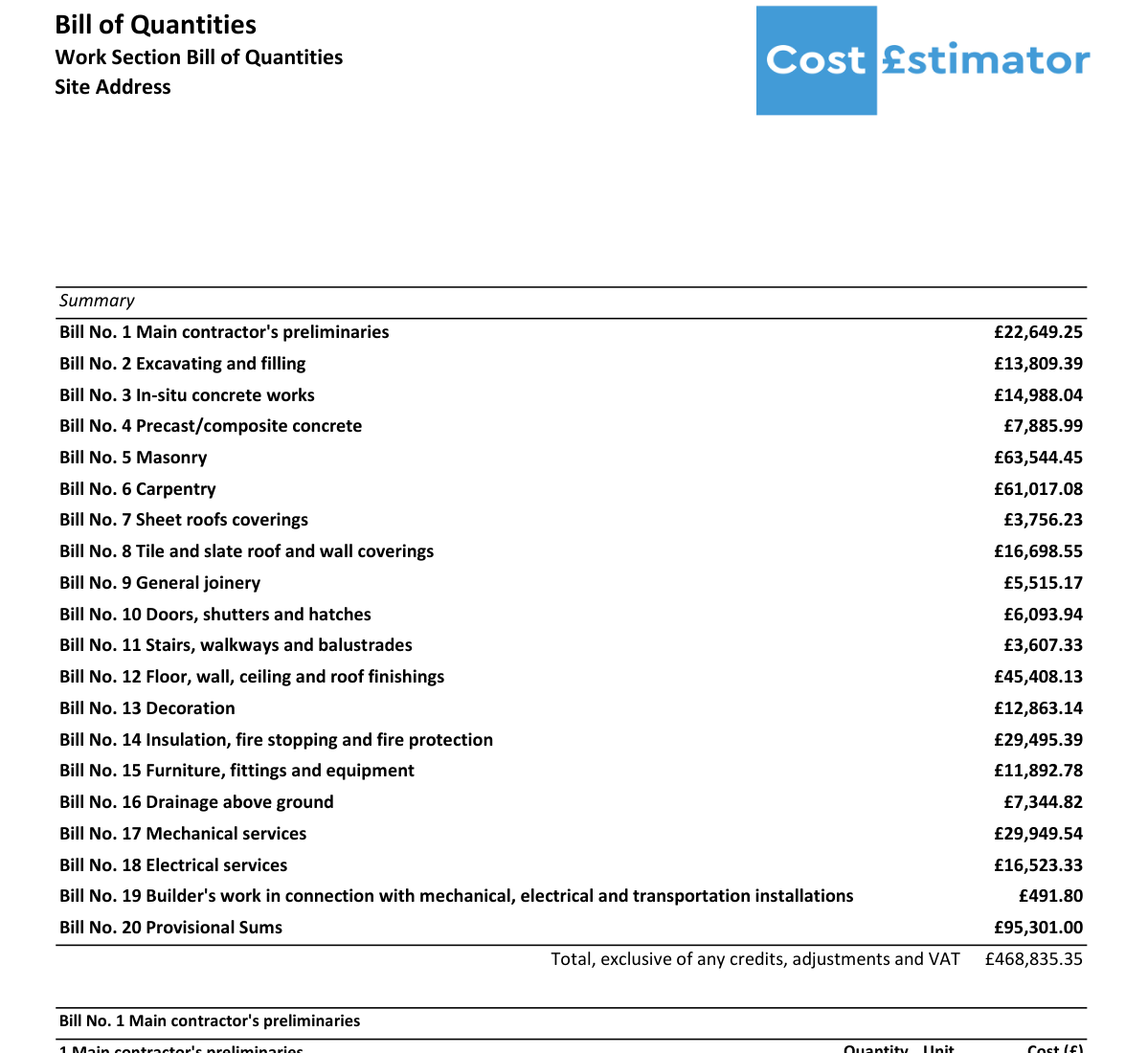
What this is: A summary from a report titled Work Section Bill of Quantities, arranged by work section. The visible fields include the bill reference, work-section description and subtotal. No claim is made here that it was prepared in accordance with NRM 2 or another stated measurement standard.
Why it matters: A single total cannot show where the budget sits. Work sections let the team see the relative weight of preliminaries, groundworks, structure, finishes, services and provisional work.
Basis shown: The summary moves from main contractor’s preliminaries through measured work sections and provisional sums, then reconciles to the more detailed descriptions, quantities and priced items below it.
What remains uncertain: A summary alone does not explain drawing revisions, assumptions, exclusions or the status of provisional items.
Client check: Confirm that every major part of the intended scope has a home in the breakdown. A missing section can be more important than a cheap rate inside one that is present.
2. Measured preliminaries and project-specific costs
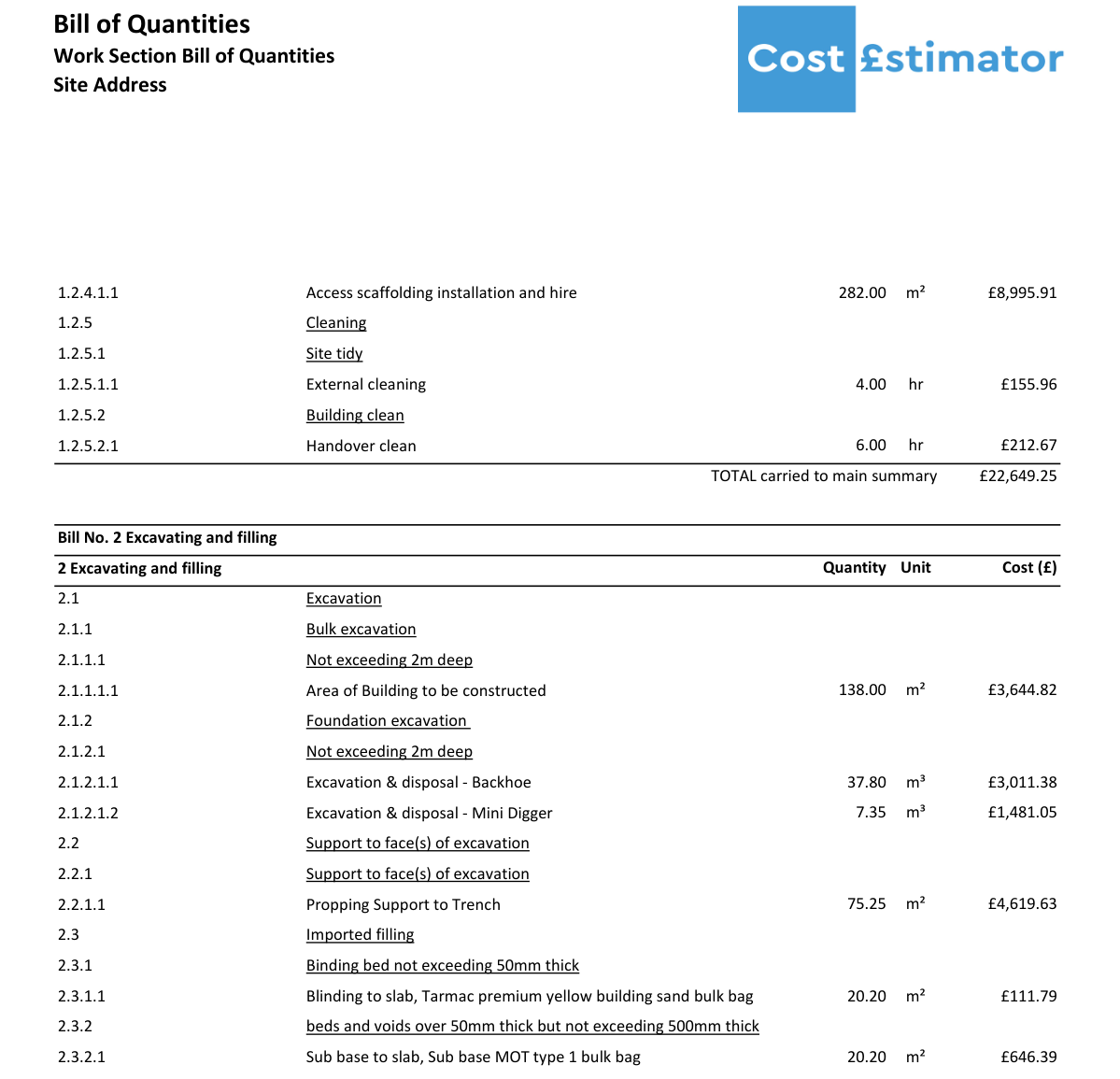
What this is: Items covering site establishment and project-wide contractor requirements, followed by measured work sections. The visible columns show item description, quantity, unit and cost.
Why it matters: Site setup, access, welfare, security, temporary works, scaffolding, cleaning and plant are real project costs. Where they are carried as a percentage or lump-sum allowance, the basis should be stated so comparisons can be made consistently.
Basis shown: Descriptions, units, quantities and values are visible rather than rolled into one unexplained allowance.
What remains uncertain: The right preliminaries depend on programme, access, phasing, working restrictions and the contractor’s delivery plan.
Client check: Check that the allowance reflects the actual site and expected duration. A programme change can alter preliminaries even when the physical scope stays the same.
3. Labour, materials and plant
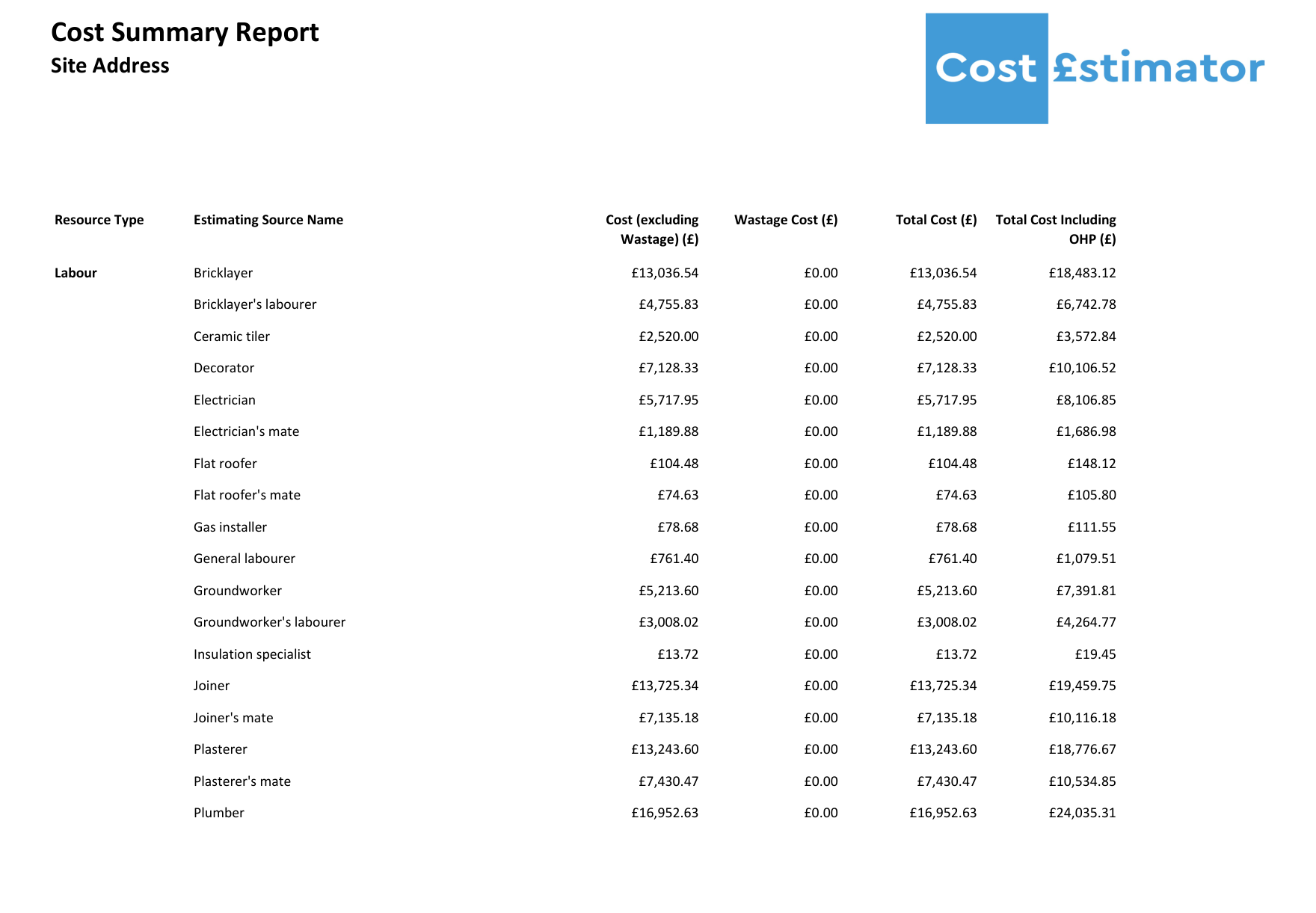
What this is: A labour-resource summary showing how individual labour categories contribute to the estimate. Other report pages summarise materials and plant separately. The visible columns distinguish base cost, wastage, total cost and total including overhead and profit.
Why it matters: A transparent resource basis helps distinguish a measured build-up from a headline square-metre allowance or an unsupported lump sum.
Basis shown: Resource type, base cost, wastage where relevant, total cost and the total including overhead and profit are separated.
What remains uncertain: A report should also state the pricing date, regional basis, productivity assumptions and whether important specialist costs came from quotations or allowances.
Client check: Do not reuse a displayed labour or material figure on another project. Rates change with location, date, package size, specification, availability and the way the work is procured.
4. Overhead and profit
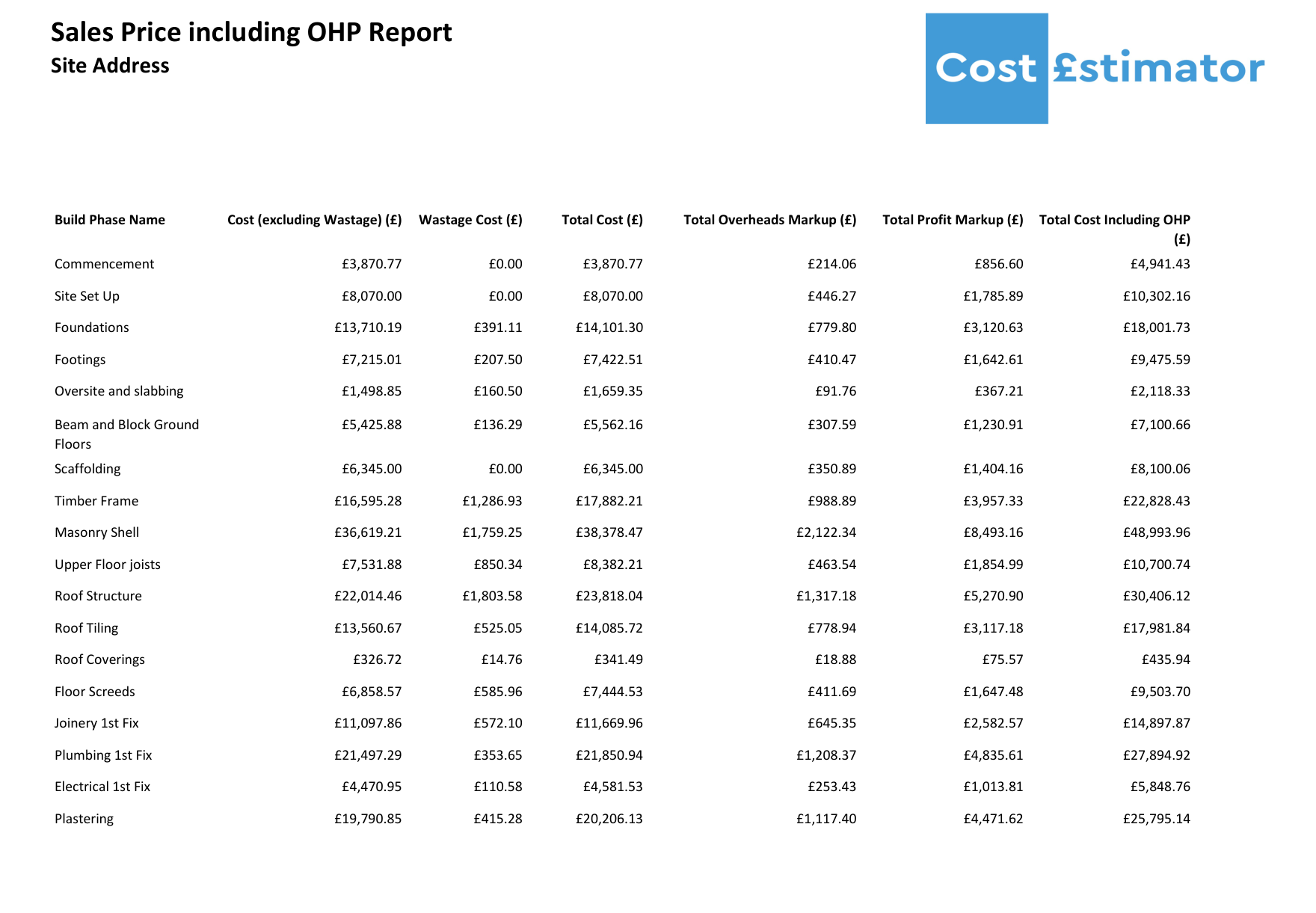
What this is: A marked-up estimate view—labelled Sales Price including OHP in the source report—that shows base cost, wastage, overhead and profit separately. The label does not, by itself, make the report a contractor’s quotation or offer to carry out the work.
Why it matters: Overhead, profit, risk and contingency are different things. Combining them into one unexplained addition makes it difficult to understand the commercial position.
Basis shown: The example exposes the calculation rather than presenting only a final marked-up total.
What remains uncertain: There is no universal UK markup that suits every contractor or job. The right treatment depends on the business, procurement route, package risk, programme and responsibility being taken on.
Client check: Where the output is intended to represent a main contractor’s selling price, confirm whether subcontract quotations still require allowances for management, coordination, attendance, overhead and profit.
5. Programme and timing
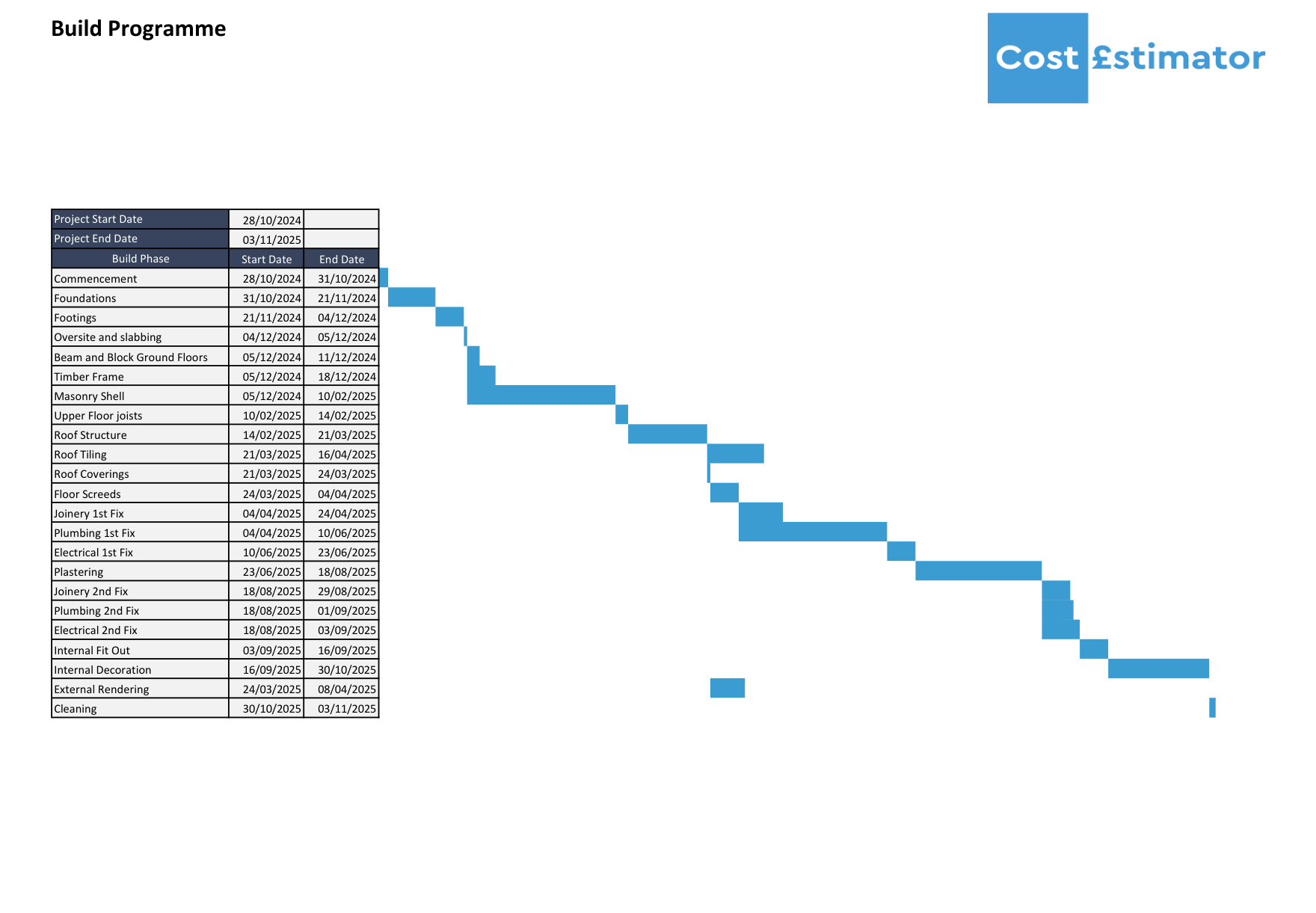
What this is: A programme linking work phases to an indicative sequence and duration.
Why it matters: Time affects supervision, welfare, access equipment, temporary works, plant, labour continuity and inflation exposure. An estimate that assumes a programme should make that assumption visible.
Basis shown: The sample identifies the planned order and duration of major phases.
What remains uncertain: A pricing programme is not a guaranteed construction programme. Design changes, approvals, procurement, weather, access and contractor sequencing can alter it.
Client check: Compare the programme basis with the proposed start date, lead times and site restrictions. If the programme changes materially, ask whether the estimate needs updating.
6. Material quantities and wastage
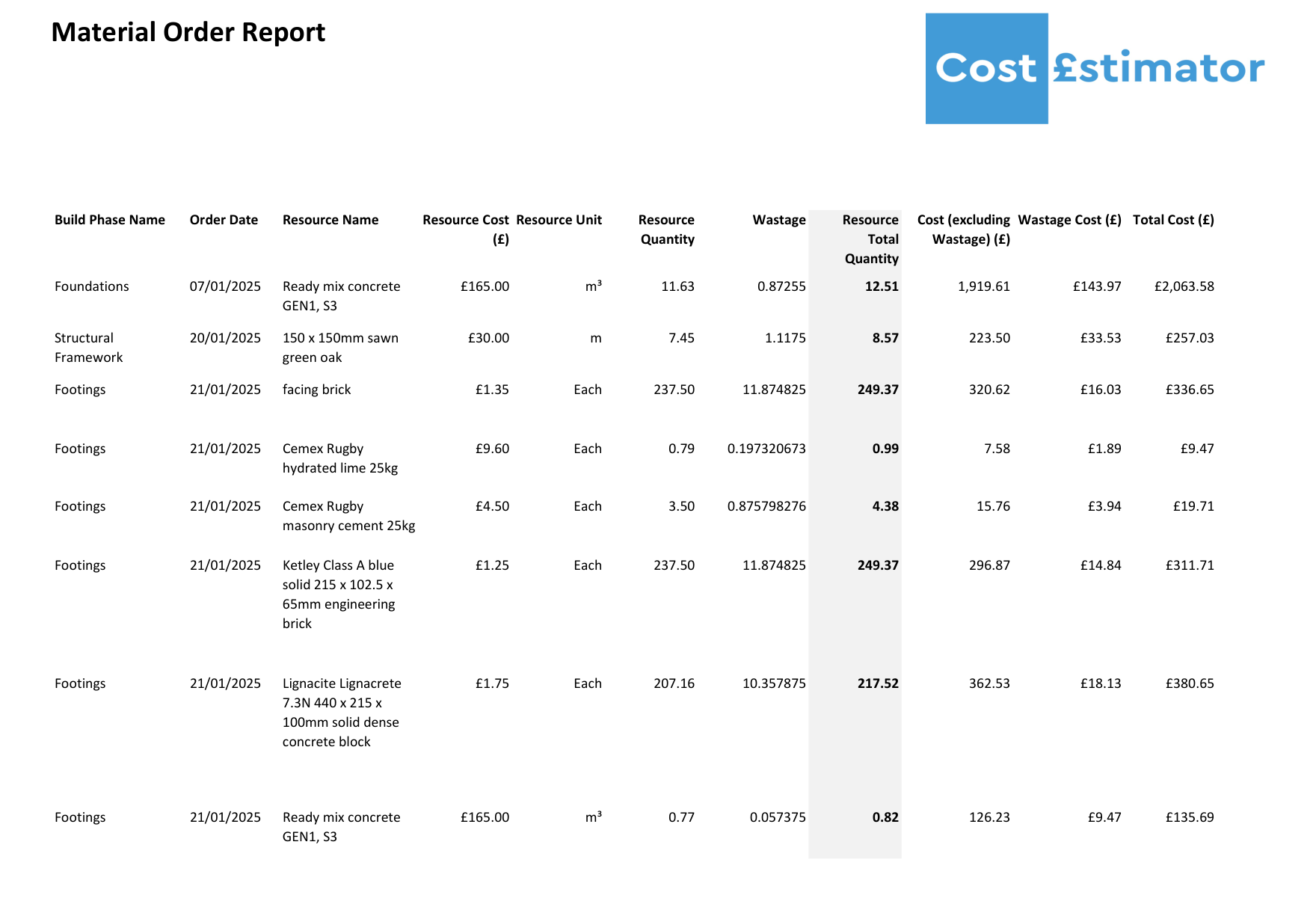
What this is: A material schedule separating measured quantity, wastage and total order quantity.
Why it matters: The amount measured in the finished work is not always the amount that must be bought. Cuts, laps, breakage, pack sizes and site handling can all affect the order quantity.
Basis shown: The visible fields include build phase, order date, resource description, unit rate, unit, measured quantity, wastage, total order quantity and cost.
What remains uncertain: Wastage is specification- and method-dependent. A percentage that works for one material or layout may be wrong for another.
Client check: Confirm that important products match the specification and that substitutions, pack sizes, delivery charges and lead times have been dealt with.
7. Reconciliation to the headline total
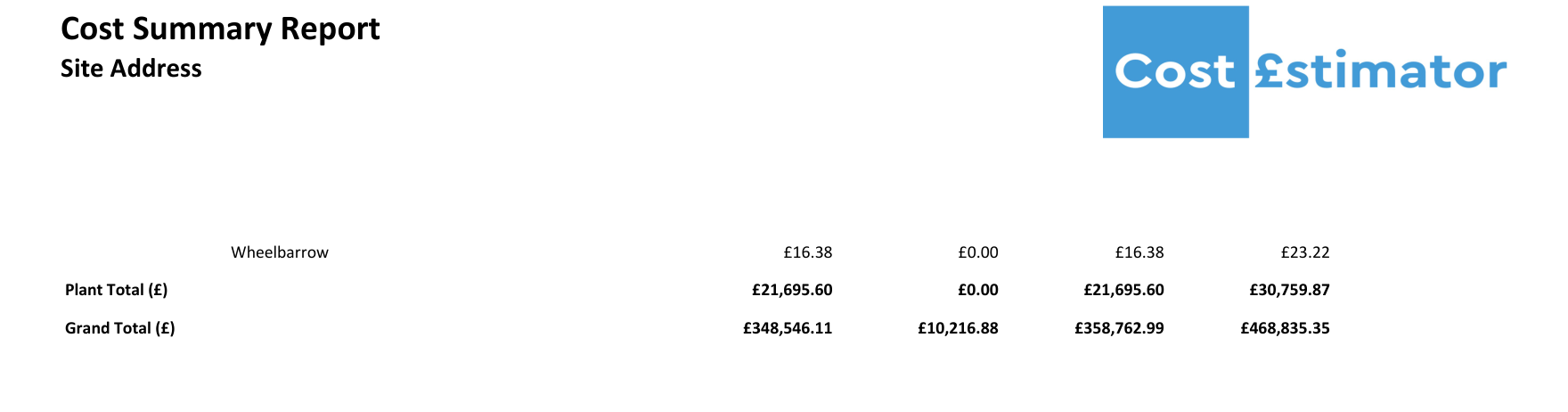
What this is: The final reconciliation between base resource cost, wastage and the total including overhead and profit.
Why it matters: The headline figure should be traceable. A reader should be able to move from the total back through work sections and resource build-ups without finding unexplained additions.
Basis shown: The columns reconcile the detailed calculations into the report total.
What remains uncertain: The source BOQ states that its total is exclusive of VAT. The treatment of professional fees, statutory charges, risk allowances and scope exclusions is not evidenced by this summary and should be checked in the accompanying estimate information.
Client check: Before comparing two estimates, put them on the same basis. Check VAT, scope, exclusions, provisional sums, programme, overhead and profit rather than comparing the bottom line alone.
What this sample does not prove
This example shows how measured and priced information can be organised. It does not mean every estimate should use the same headings, rates or markup. It also does not show every control that should accompany a detailed estimate.
Before relying on an estimate, look for or request:
- the drawings and specification revisions used
- the pricing/base date
- assumptions made where information was missing
- exclusions and client-supplied items
- VAT treatment
- provisional sums and specialist allowances
- risk or contingency treatment
- the estimate version and revision notes
- the intended use of the estimate
The UK Government’s cost-estimating guidance is written for public projects, but its core discipline is useful more widely: document the methodology, assumptions and evidence behind the estimate, distinguish base cost from uncertainty and risk, and review the output before it drives a decision. RICS NRM 1 provides a framework for order-of-cost estimating and cost planning; NRM 2 addresses detailed measurement for building works. These references do not establish that the sample was prepared in accordance with either standard or that the service is RICS-regulated.
How to assess whether an estimate is usable
Ask five questions.
- Can you see what was priced? The scope should connect to drawings, specifications or an agreed written brief.
- Can you trace the total? Major work sections and additions should reconcile to the headline figure.
- Can you see what is uncertain? Assumptions, exclusions, provisional items and risk should not be buried.
- Can you compare it fairly? For alternative estimates or tender returns, align scope, VAT treatment, programme assumptions and specialist-package coverage. Identify how overhead and profit have been treated, recognising that each contractor’s commercial allowances may differ. The separate guide explains how to obtain and compare building estimates.
- Can it be updated? A useful estimate has a date and version so design or scope changes can be priced without starting from a mystery number.
If those questions cannot be answered, the problem is not necessarily that the figure is wrong. It is that the basis is too weak to rely on confidently.
Related guides
- What drawings do you need for a building estimate?
- How to get and compare a building estimate
- How a bill of quantities is prepared
- Construction estimating service
Questions about the example
What does this construction cost estimate example show?
It shows how work sections, measured preliminaries, labour, materials, plant, overhead and profit, programme information and material quantities can be organised and reconciled to a headline total.
Are the rates and totals in the example current?
No. The extracts are historical and relate only to the anonymised example project. Do not reuse the displayed rates, quantities, totals or programme dates for another job.
Is this a formal RICS cost plan or chartered QS report?
It is not presented as either. The sample is an estimator’s output and does not establish that it was prepared by a chartered quantity surveyor or in accordance with a stated NRM measurement standard.
How should I compare this example with another estimate?
Compare the scope, drawing and specification basis, quantities, assumptions, exclusions, VAT treatment, provisional items, programme, overhead and profit. Put both estimates on the same basis before comparing their headline totals.
Can Cost Estimator prepare an estimate from my plans?
Yes. Send the available drawings and scope through Upload Plans. If the work is clearly defined and fits a standard bookable route, Quick Quote lets you order and pay for professional estimating work. If you are unsure which route fits, use Contact.
Get a project-specific estimate
Send the drawings, specification and any scope notes you already have. We can confirm what can be measured, what still needs an allowance and which route fits the job.